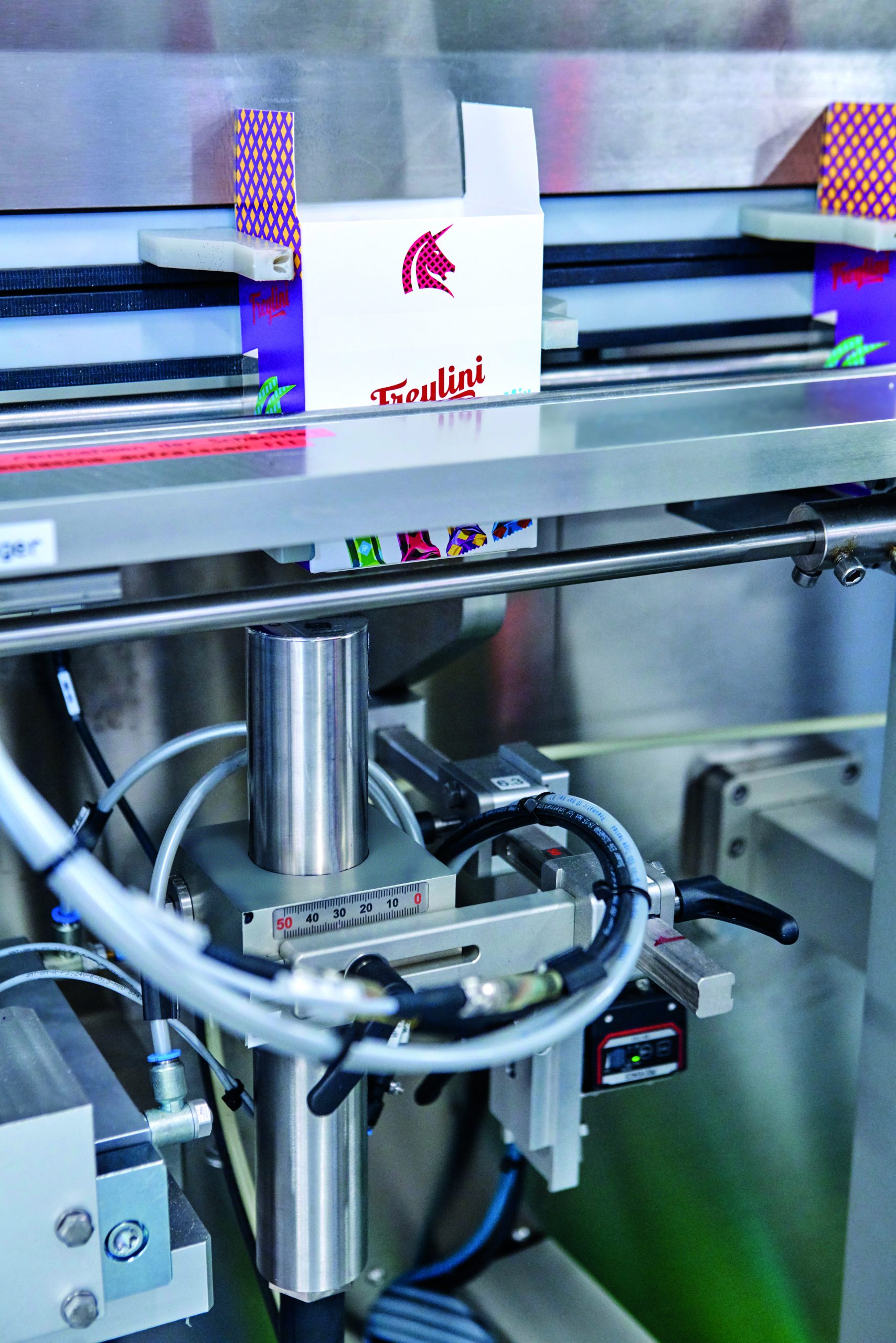
Flexible packaging — sachets, stand-up pouches, flow-wrapped snacks and laminated films — is one of the fastest-growing formats on South African production lines, and it is also one of the hardest to code cleanly. Thermal transfer coding for flexible packaging solves that problem directly: a heated printhead presses a high-resolution code onto the film as it runs. This post explains how thermal transfer overprinting (TTO) works, how to match it to your line, and when it beats inkjet or laser.
Why flexible film defeats other coding methods
Flexible film is a difficult substrate. It is non-porous, often glossy or laminated, and it moves through the machine under tension on a flow-wrapper or vertical form-fill-seal (VFFS) line. Continuous inkjet drops can smear or bead on tightly sealed film, and the small character matrix struggles to carry a legible 2D barcode at speed. Laser marking works on some films but risks compromising a barrier layer if the parameters are wrong. Thermal transfer overprinting sidesteps both issues. Because it transfers a solid resin or wax image from a ribbon onto the film under heat and pressure, it produces a dense, smudge-resistant code with no liquid ink to dry and no substrate damage.
That print quality matters most where the code is more than a date. South African food, pharmaceutical and cosmetic manufacturers increasingly need ingredient panels, allergen statements, GS1 barcodes and batch traceability data printed in the same pass — not just a best-before date. TTO is built for exactly that density of information on film.
How thermal transfer overprinting works
A TTO printer holds a thin polyester ribbon coated on one side with a meltable ink. A printhead made up of tiny heating elements presses the ribbon against the packaging film and selectively heats it, transferring ink onto the surface dot by dot. Most industrial printheads run at 300 dpi, which is high enough for small fonts, logos, GS1-128 barcodes and DataMatrix codes. The ribbon advances after each print so a fresh section is always presented to the printhead, and a take-up spool collects the spent ribbon.
The result is a permanent, high-contrast code applied with no solvents and almost no operator intervention between ribbon changes. Our range of thermal transfer overprinters is designed to drop into existing flow-wrap and VFFS lines without re-engineering the machine.
Intermittent versus continuous TTO: match the printer to your line
TTO printers run in one of two modes, and choosing the wrong one is the most common specification mistake.
- Intermittent printers code while the film is stationary — during the dwell of a VFFS or tray-sealing cycle. The printhead moves across a flat platen, prints, and retracts before the film indexes forward. Typical speeds run from about 10 to 700 mm/s, suited to lines that stop and start.
- Continuous printers code onto film that never stops, as on a horizontal flow-wrapper. The printhead stays fixed against a rubber roller while the film moves beneath it, generally at 50 to 700 mm/s.
The practical rule: if your packaging machine pauses to form and seal each pack, you need an intermittent unit; if the film feeds continuously, you need a continuous unit. A snack producer running high-speed flow-wrappers and a sachet filler running VFFS may need different TTO configurations even within the same factory.
Choosing the right ribbon: wax, wax-resin and resin
Ribbon choice determines both print durability and running cost, and on a flexible film line it usually accounts for more of your total cost of ownership than the printer itself. There are three families:
- Wax — the most economical option, good on matte and paper-based films, but with limited resistance to abrasion, oils and solvents.
- Wax-resin — the practical middle ground for most flexible packaging, balancing cost against durability on coated and laminated films.
- Resin — the most durable and chemical-resistant, the right choice for packs that face refrigeration, oils, alcohol wipes or rough handling, such as pharmaceutical sachets and industrial chemical pouches.
Specifying ribbon width and length to the actual code size also controls cost. An oversized ribbon wastes metres of foil on every roll, and with ribbon priced in rand per metre that adds up quickly across a production shift. Right-sizing the ribbon and using ribbon-save functionality on the printer are the two simplest ways to cut consumable spend.
Where TTO fits on South African lines
TTO earns its place wherever the pack is flexible and the code carries real information. Snack and confectionery producers use it on flow-wrapped chips, sweets and biscuits; bakeries code resealable bread and roll bags; dairy and spreads lines mark lidding film and sachets; and condiment, sauce and instant-coffee fillers run it on stick-packs and single-serve sachets. In pharmaceutical and cosmetic manufacturing it prints batch and expiry data on powder and gel sachets where a clean, durable resin code is non-negotiable. The common thread is a film web that needs more than a date stamp. For a fuller picture of which technology suits each sector, our industries overview maps coding methods to applications across South African manufacturing.
How TTO compares with inkjet and laser on film
TTO is not the only way to code flexible packaging, and the right answer depends on the substrate and the data. For high-speed line coding on cans, bottles and rigid containers, continuous inkjet printers remain the workhorse. Where you need clean, high-resolution barcodes on cartons and secondary packaging, thermal inkjet printers are often the better fit. And for permanent, consumable-free marking on suitable films, industrial laser coders are worth evaluating, particularly where recyclability and waste reduction are priorities.
Where TTO wins is print quality and information density on flexible film specifically: the crispest small text, the most reliable 2D codes, and consistent results across glossy, laminated and metallised surfaces. If you are weighing the broader trade-offs, our breakdown of how CIJ, TIJ and laser coding compare for South African manufacturers sets out the wider decision, and the technology overview covers all four categories side by side.
Compliance and South African line realities
Whatever the format, the code has to satisfy the regulator. South Africa’s R146 food labelling regulations require a legible, indelible date mark and batch identification on pre-packaged food, and the draft R3337 regulations now working through the system will add front-of-pack and date-marking changes that put more information onto the pack. A 300 dpi TTO code carries that detail without crowding the artwork. For the fundamentals of compliant date marking, see our guide to date coding for food packaging in South Africa.
Local operating conditions matter too. Load shedding means coders are restarted far more often than in markets with stable supply, so a printer that powers up cleanly without wasting ribbon or throwing alignment is worth more than a marginal speed gain on paper. TTO handles this well: there is no ink to dry out during an outage, and the ribbon stays ready. With consumables and printheads stocked locally through our Johannesburg, Durban and Cape Town offices, replacement parts do not depend on an import lead time when a line is down.
The bottom line
For sachets, pouches and flexible films, thermal transfer coding gives you the cleanest, most information-dense code of any mainstream technology, with low maintenance and no solvents. The decisions that matter are mode (intermittent or continuous, matched to your packaging machine) and ribbon (wax, wax-resin or resin, matched to durability and cost). Get those two right and the technology largely looks after itself.
If you are specifying a new flexible packaging line or replacing an ageing coder, talk to our team for a technical assessment of the right TTO configuration and ribbon for your product.
about
Marking Solutions
Reliable coding and marking solutions delivering uptime and long-term efficiency nationwide.